
3vium (SI)
BARŽUN 442 Hz
Music-dance-literary performance, festival production premiere
Schedule
| 01.09.2026 | at 20:00 | Minorite Church |
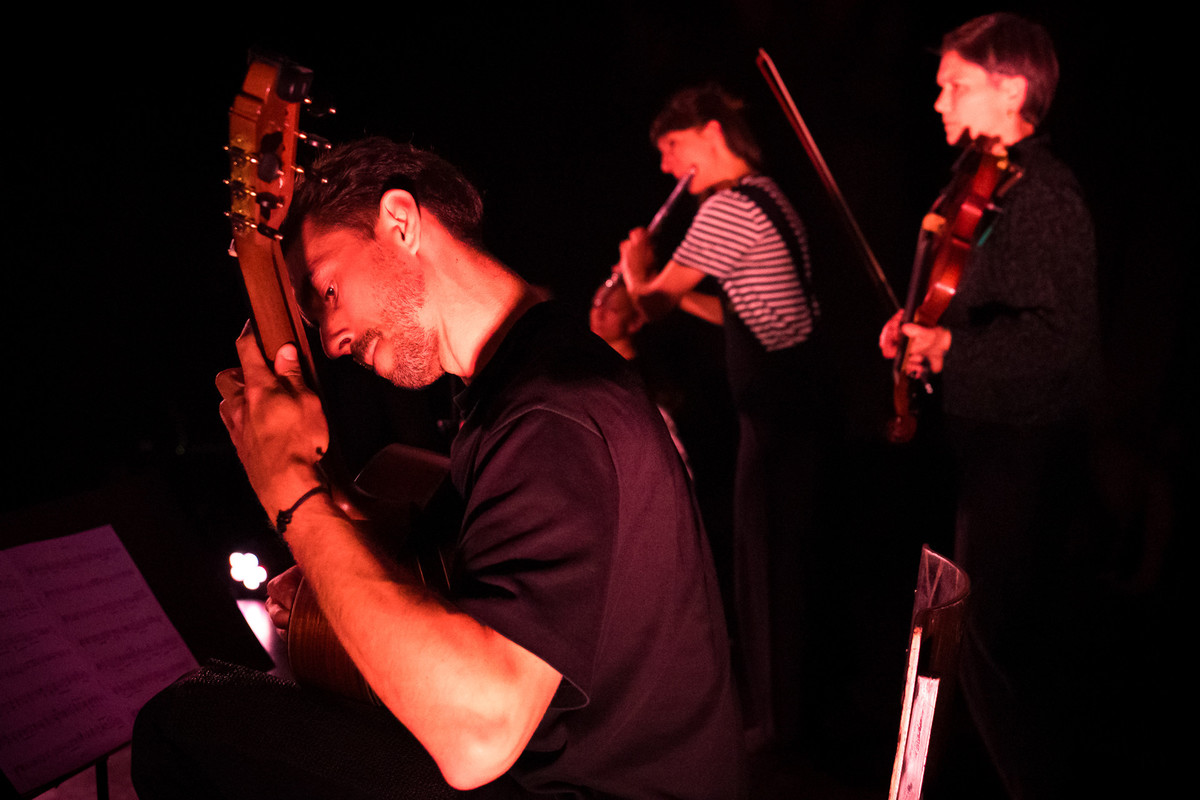
MOJA KREACIJA Institute, Maribor, 20th Platform of Contemporary Dance
Premiere September 1, 2026, at 8:00 p.m., Minoriti Church, Minoriti
The performance lasts 50 minutes without intermission.
3vium Asja Grauf (flute), Jaka Fiedler (guitar), Špela Huzjak (violin, voice, electronic effects)
Kikiriki Nina Farič (electronics)
Dance duo Jasmina Križaj, Simon Wehrli
Concept and artistic direction 3vium
Photography Saša Huzjak
Technical support Gašper Bohinec
Production 20th Platform of Contemporary Dance, MOJA KREACIJA Institute, Maribor
Executive production Mojca Kasjak
Co-production Center for Dance – Stage Gosposka, Cultural and Artistic Association Kreativni regenerator, Maribor Puppet Theatre
Baržun 442 Hz is an interdisciplinary performance combining music, dance, and poetry into a holistic artistic experience. It is based on encounters between artistic genres, creators, and modes of expression that intertwine into a shared narrative. The musical framework includes contemporary composed music (Baden Powell, René Eespere), Baroque (J. S. Bach), electronic and original music, as well as improvisation in dialogue with movement and text. The two dancers expand the musical structure, creating a dynamic, spatially expansive performance. Movement acts as a bridge between sound and words, responding to and extending musical and literary motifs. The performance also features poetry by Srečko Kosovel, whose verses function as performative elements, resonating through music and movement.
3vium is a Maribor-based ensemble that combines classical guitar (Jaka Fiedler), flute and recorders (Asja Grauf), and violin, vocals, and electronic effects (Špela Huzjak) into a unique musical experience. Their repertoire spans various periods of classical music—from the Baroque to the contemporary—incorporates Latin American rhythms, and features the ensemble’s original compositions.
Špela Huzjak, a violinist, vocalist, performer, and educator, completed her violin studies at the Academy of Music in Ljubljana, furthered her training in Lahti, Finland, earned a specialization at the University of Graz, and studied jazz violin in Klagenfurt. In addition to instrumental music, she is interested in the relationship between instrument, voice, and body.
Jaka Fiedler is an academic musician and guitarist who completed his undergraduate and graduate studies in classical guitar at the University of Music and Performing Arts in Graz, in the class of the renowned Polish guitarist and virtuoso Łukasz Kuropaczewski.
Asja Grauf, a classical musician, flutist, and flute professor, studied at the University of Music and Performing Arts in Graz and at the Giuseppe Tartini Regional Conservatory in Trieste. She performs in various musical genres and in ensembles specializing in electroacoustic and improvised music.
Nina Farič—Kikiriki, a solo noise artist. She focuses on experimenting with live-produced sound, primarily from analog synthesizers and DIY electronic circuits. As Kikiriki, she has released nine albums, including a couple of collaborations. Most of the recordings were made live, either in the studio or at a concert. In addition to experimental sound, she also DJs noisy music.
The dance duo Jasmina Križaj and Simon Wehrli began their artistic collaboration in 2011. Together, they have created the performances False Entries (2012), Greatest Hits (2013), Nature Poetry (2018), Deep Purple vol. 1 (2019), and Nothing Works (Shakira, Shakira)—a duet (2019), as well as Deep Purple (2022, with Daniel Gisler). In their projects, they explore how specific movement unfolds across a temporal spectrum and is conveyed to the audience through the senses. Alongside their physical exploration, they have also developed a method of documenting their work through writing, poetry, images, and sound. Sometimes, these so-called byproducts become part of the choreography. Their practice focuses on exploring bodily presence, transitions between the intimate and the collective, and the "gray areas" between dance, music, banality, humorous interludes, and the immediacy of everyday movement.